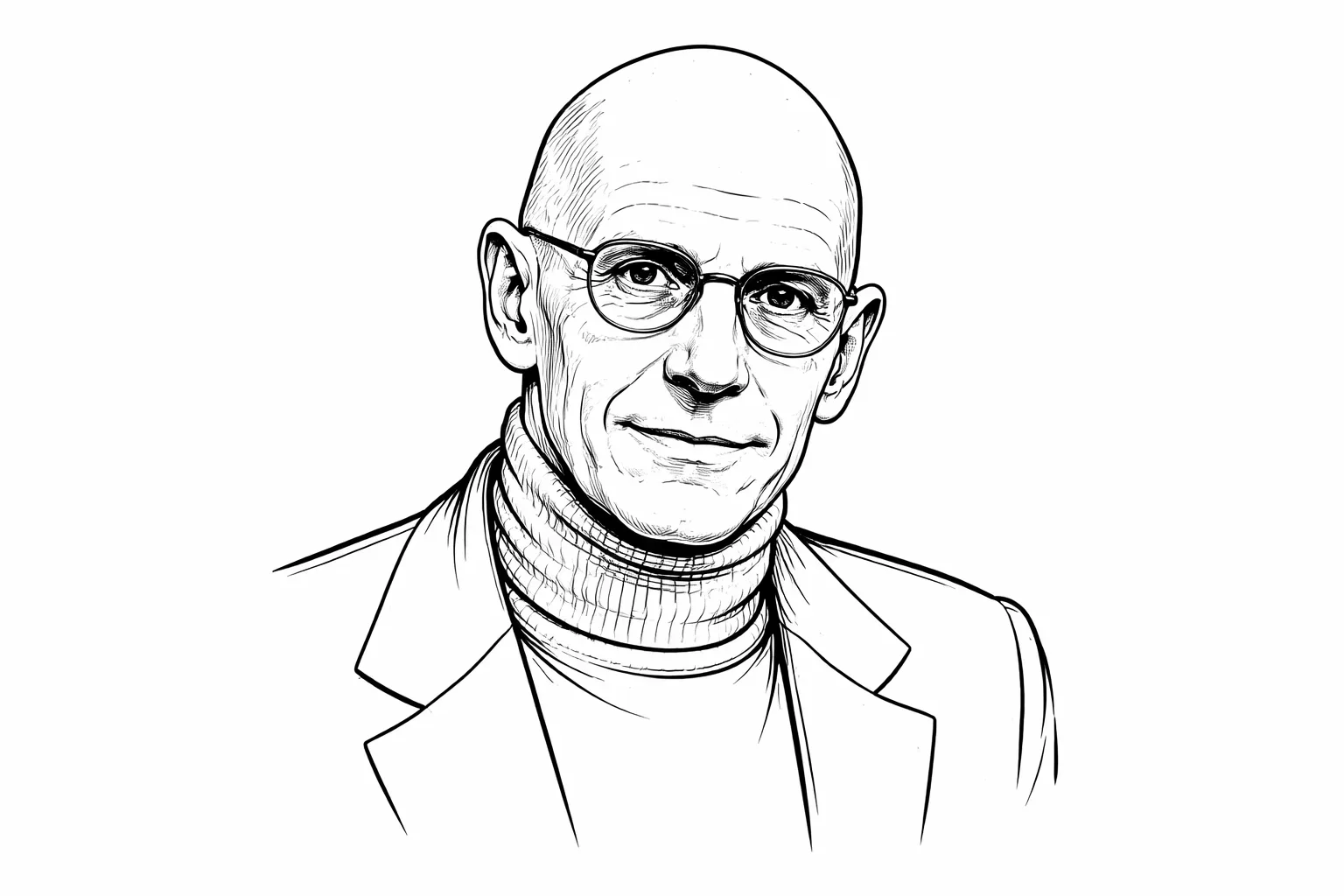
We meet at a clandestine location. We are wearing disguises. I am disguised as an old man with meringue-white hair tied into a ponytail, a drinker’s nose and oversized ears. Foucault, on the other hand, is disguised as a young woman with a raw-boned visage, wax-yellow complexion and raccoon rings around the eyes. We discuss business for about three quarters of an hour, agree terms and then we make small talk until it’s time to leave. Foucault tells me about his brothers, about how the one who works for him recently got out on parole and how the other brother, the one who has a cupcake business, split from his wife after finding her in bed with one of the mestizos from the cupcake factory (who, naturally, we subsequently dealt with, he clarifies). For my part, I tell Foucault about how I recently decided to turn my swimming pool into a pond and fill it with koi carp. That’s a weird thing to do, he says. I shrug, say to me it makes perfect sense, because it does, not that it matters whether it does or not.
The meeting ends with each of us being escorted by our respective henchmen away from the clandestine location. My henchmen are in a jovial mood, having probably taken illicit substances whilst they were waiting for me. We walk through the jungle slashing at the undergrowth with our machetes. After two or three hours we make it to the road where our SUVs are parked. We drive in a convoy, with my SUV in the middle. The head henchman, who goes by the name of Derrida, drives with me sitting in the front passenger seat, revolver on his lap, finger on the trigger. We listen to music from my Apple playlist, which is set to shuffle mode.
* An anodyne rock anthem; a vituperative anarcho-punk song spit-screaming about the exigent need for violent insurrection; a mournful yet flamboyant New Romantic pop ballad promulgating sexual ambiguity; an old-school jungle track with dubious undertones; and “Billie Jean”. *Just at the point Michael Jackson is repetitively disclaiming that Billie Jean is his lover we arrive back at the tower block. We park in the underground carpark. The guys return to their desks and resume doing their cover jobs. I go straight up to the penthouse and the first thing I do is pour myself a large Scotch, which I drink in one heartburn-inducing gulp. I go to the bathroom, peel my skinsuit off, scrutinise myself in the mirrored wall for a minute or two – trying out different angles and poses but not finding any of them to be satisfactory – and then I get in the shower. As I am showering, I think about the deal I struck with Foucault at the clandestine location, turning over the terms in my mind. After due consideration, I am forced to admit that the deal seems to work to Foucault’s advantage and to my detriment, which is strange because I had precisely the opposite intuition in the meeting. I have been bamboozled it seems. I smile at the sheer ridiculousness of it. I was warned about Foucault, but I didn’t listen to whoever warned me. (It’s an issue I have, not listening to other people, even when I trust and like them, perhaps especially then I don’t listen to them.)
After the shower, I send Derrida a text asking him to come up to the penthouse. ‘I’ll be in the pool room’ I text again a few seconds later. I put on a pair of Speedos and ride my Segway through the penthouse to the pool room, which is: a) housed in a dodecahedron-shaped glass annex, b) themed as a tropical paradise and c) my go-to place for relaxation. I climb an avocado tree in a monkey-like manner until I get to the wooden platform, which I clamber up onto. I leap off the platform clutching a vine. I swing across the pool (or pond or whatever) emitting the trademark Tarzan yell and then I let go when I swing back again. I make a tremendous splash as I enter the water with my arms and legs flailing. The koi carp scatter (like sparks from a bonfire on a blustery autumnal night?). I do three breast strokes over to the sweetcorn-yellow lilo, haul myself up onto it and then stretch out on my back. I shout out: Hey Siri, play “Tubular Bells”.
I float for a while, staring up at the melancholic, somewhat sinister cloud faces through the vaulted glass roof, savouring my favourite record of the 1970s, which is, as any aficionado of 1970s pop music will know, not an accolade one bestows lightly. When Derrida arrives, I gesture for him to sit himself down on one of the sun loungers on the artificial beach. I order Siri to turn the music off. Derrida, I say, we have a problem. Boss, he says, sitting down. He lights up a cigarette and for a moment I feel an urge to light one up too, but then I remember that I quit smoking three days ago. I explain to Derrida that we need to teach Foucault a lesson. Derrida, who has had a lot of work done and is no longer able to make facial expressions, stares at me like a mannequin. Foucault? he says with his lips barely moving (as if he were performing a dummy-less ventriloquist’s act?). Yeah, I say, the fucker fucked me on that deal. Then I explain in great detail what I want Derrida to do, who nods avidly to signify his cognisance, or at least that is what I presume his nodding signifies.
I put on the Lacan skinsuit, followed by a pair of skinny stonewash jeans and a white t-shirt with a charcoal-style portrait of Baudrillard emblazoned on it that I immediately cover over with a black turtleneck sweater, which has a line-art portrait of Barthes smoking a cigarette printed on it. I take the lift from my apartment down to the eighth floor. I see two patients before lunch. One of the patients tells me that shadowy state operatives are surveilling his every move, his every thought. He can’t prove it, it’s just something he knows deep down to be true. Like how my sexuality is socially constructed, he says. Of course, my wife thinks I’m bat you-know-what crazy. I tell the patient that in my experience people who accuse other people of being crazy are often crazy themselves and that nine times out of ten when you have a hunch you’re under surveillance you actually are under surveillance. The other patient barks every so often, barks like a dog I mean, but otherwise seems completely normal. He tells me in staccato bursts of language in between barks that he feels his involuntary barking is preventing him from leading a normal life and that he is, quite frankly, at the end of his tether. If you’ll pardon the pun, he adds. I tell him that barking never hurt anyone and there is no such thing as a normal life or if there is it’s overrated. The patient seems unconvinced and I can’t blame him for that. Oh well, I think or say, and then I call time.
I meet Lyotard for lunch at a French or Spanish restaurant. He’s disguised as a winsome brunette with movie star veneers. It’s a balmy day, so we sit outside at one of the tables athwart the exhaust-fumed sidewalk. We drink espressos. I have supplementary water with mine, Lyotard drinks his neat. We reminisce about old times for a bit and then I switch the conversation onto a business footing. I tell him that Foucault has overstepped the mark and that I’m going to teach him a lesson he won’t forget in a hurry. Lyotard cautions me against doing anything rash and I say what’s it to him. What’s it to me? he says. Yeah, what’s it to you? Nothing, I just think you need to tread carefully with Foucault, that’s all. I ask him to clarify and he recounts a cautionary tale about Foucault (he doesn’t say it’s a cautionary tale, I add that epithet myself because I think it’s appropriate to do so). After hearing him out, I tell Lyotard that I am now even more determined to teach Foucault a lesson. We cannot, I say (slamming my fist on the table for emphasis), with good conscience allow his underhand and devious tactics to undermine the cartel! To which Lyotard shrugs in a noncommittal manner, which is just like him.
* A street cluttered with painfully thin grey-brick terraced houses, dog excrement scattered pell-mell over the pavement, hooded hoodlums smashing a car with implements, a toothless guy squatting on a doorstep jabbing a needle into a pustulating sore in his groin as his wretchedly malnourished dog watches in disgust or despair, a young woman in a branded tracksuit swaying like an unstable bridge in a severe gale, a mound of fly-tipped garbage occluding the entrance to the window-grilled shop on the corner, a shop with a radioactive-green neon sign above the window that reads: ABSINTHE FOR SALE HERE. *I watch as the white van works its way along the street from my vantage point behind a yellowy net curtain. When the delivery driver (aka Foucault, whose cover job it is to deliver parcels for an online retail company that has pullulated across the globe like an out-of-control coronavirus) knocks on the door, I have Derrida answer it. I hear Foucault say he has a delivery for Barthes and then there is a dull thud like a sandbag being whacked with a spade, followed by an unnatural high-pitched squeak that reminds me of Beaker (you know, from The Muppets), followed by the sounds of scuffling, followed by several more thuds and then silence or what would have been silence if it weren’t for the wailing of a police siren.
Moments later, Derrida enters the parlour with Foucault slung over his shoulder, limp as a ragdoll. He plonks Foucault down on the beanbag. I thank Derrida for a job well done and tell him to leave us alone. I pick at my teeth (I had a fillet steak for lunch) as I wait for Foucault to come round.
I get bored waiting for Foucault to regain consciousness, so I summon Derrida by text and have him administer an adrenalin injection. As soon as Derrida’s jabbed him (in the bum), Foucault gasps, clutches his chest for some reason and his eyes ping open. He has a look of abject horror on his face, the kind of look you see a lot of in zombie apocalypse movies. He tries to get up but he can’t get any purchase on the beanbag and he merely sinks deeper into its voluptuous embrace. I tell Derrida to leave us again and he dutifully trots away to the adjacent room where the other henchmen are congregated. Foucault, I say, we need to talk. We do? Uh-huh. About what exactly? I unsheathe the Gerber Mark II from its scabbard and I say: I’ll ask the questions if you don’t mind. And then a strange thing happens, very strange, which is this: Foucault peels off his delivery-driver skinsuit to reveal Nietzsche of all people! Nietzsche, I say, is that really you? Yes, he says, you had better fucking believe it!
Turns out Foucault was Nietzsche all along. Turns out Nietzsche was testing me to see if I was ready for a promotion. Turns out I passed the test with flying colours. My mother, if she were alive and she had ever given a shit about anything other than where her next drink was coming from, would have been proud. A real selfie moment. Bow please.
Before I head off to Switzerland to begin my new role, I promote Derrida to my old position. I can’t tell if he’s happy about the promotion because of his expressionless face, although he says he is (not that that means anything of course). I do a handover for a week or so, during which Derrida asks me so many questions that I begin to question whether I should have promoted him in the first place (the world, as you know, is full of people who have been over-promoted, normally by virtue of their good looks, which is, I can assure you, not the case when it comes to Derrida).
I leave in spite of my reservations about Derrida. After all, what do I care if he fucks up?
I meet Nietzsche in a chintzy bar in Geneva. He orders absinthe – which I am surprised by because I thought he was teetotal – and I have one too to be sociable. He explains a bit about the new role, how I don’t have any line management responsibility anymore, but that this is more than compensated for by the intellectually stimulating nature of the work I will be doing and the pay, of course, which has been rigorously benchmarked he assures me. I say something about it not being about the money, that it’s a nice-to-have of course, but that my main motivation is the work. Nietzsche smiles at that, says he and the other philosophers in the inner sanctum have every confidence that I am absolutely the right woman for the job. He orders two more absinthes. When the drinks waitress (who is dressed as an Arcadian milkmaid) brings them over, Nietzsche tips her 1000 Swiss francs. Then he raises a glass. To your success, he says. We clink glasses and down our absinthes. We drink three more absinthes each in rat-a-tat succession. At some point things start to get weird, by which I mean everything around me takes on a Cubist or Dadaist appearance and I suddenly can’t make head or tail of what Nietzsche is saying. I excuse myself, go to the toilet, shut myself in a cubicle, put my head in my hands. It’s all just a simulation of the real, I hear myself saying repeatedly as my consciousness falls ineluctably into a spiral inside itself.